
Sleep, Hormones and Nutrition

Sleep, Hormones and Nutrition:
A Functional Guide to Better Rest
Many people struggle with falling asleep, staying asleep, or waking up refreshed. The natural question becomes: how do we fix it? Sleep is fundamentally controlled by hormones, and these hormones are deeply influenced by your daily habits and nutrition. This means that by adjusting how you live, you can shift these hormones in the right direction. Lifestyle interventions often create deeper, more sustainable improvements than medication alone. Below, we explain how your daily rhythms, lifestyle choices, and nutrition work together to shape your sleep — and how you can use this knowledge to improve it.
Your Circadian Rhythm: The Hormonal 24-Hour Clock
Your sleep is regulated by a built-in clock called the circadian rhythm, which is guided by light, behavior, and feeding patterns. Two key hormones dictate this rhythm: cortisol and melatonin. Though commonly known as a stress hormone, cortisol is also an essential daytime activator. It naturally peaks in the morning to help you wake up, think clearly, and move, and it gradually declines throughout the day. Cortisol’s counterpart is melatonin, your nighttime signal. It rises in the evening when light decreases, and tells your brain and body: it’s biological night — time to sleep, repair, and recover.
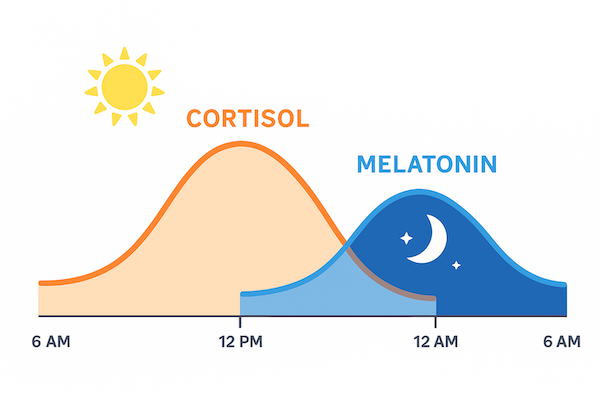
To support these rhythms, it is crucial to front-load your energy demands, and back-load your recovery. Trying to do the opposite confuses your hormonal timing and makes sleep less restorative.
✔ Morning: activity, sunlight, exercise, workload.
Evening: slow down, dim lights, avoid stimulating tasks.
✘ Late meals, late workouts, late blue light, late stress.
What You Consume — and When
Stable blood glucose is essential for normal sleep. When blood sugar drops too sharply — often a rebound from high-glycemic meals, irregular eating patterns, or poor insulin sensitivity — the body responds by releasing adrenaline and cortisol to correct it. This counter-regulatory surge can trigger nighttime awakenings, sweating, racing thoughts, or a sudden feeling of alertness at 2–3 a.m. Conversely, chronically elevated glucose and hyperinsulinemia blunt melatonin secretion, disrupt slow-wave sleep (deep sleep), and impair the depth of overnight recovery. In short: both “too high” and “too low” destabilize sleep through hormonal mis-signaling. Improving insulin sensitivity — through movement earlier in the day, balanced meals with low glycemic load, building muscle mass, consistent eating windows, and reducing late-night snacking — directly stabilizes the hormonal environment required for deep, continuous sleep.
Not only meal timing and glycemic load are nutritional factors linked to sleep, so are certain micronutrients. Magnesium is a prime example, playing a crucial role in calming the nervous system and supporting the function of GABA, a neurotransmitter that promotes relaxation. Deficiency is common and supplementation can significantly improve sleep quality for those who lack it. Similarly, omega-3s and vitamin D can support sleep in specific cases. Optimizing levels of these nutrients through a nutrient-dense diet or targeted supplementation where a deficiency exists creates a more supportive biochemical environment for restorative sleep.
A Side Note on Caffeine and Alcohol: Debunking Myths
Caffeine: Caffeine blocks adenosine, the molecule that builds sleep pressure, and its effects can last 6–12 hours. This is why even afternoon caffeine can reduce deep sleep and increase nighttime arousals. What people often do not realise, however, is that sleep can still be disrupted even if you “don’t feel it.” Therefore, be cautious with coffee, even if you believe you are “immune” to its effects.
Alcohol: Alcohol has a sedative effect and is therefore commonly perceived as an effective “nightcap.” What people are often not aware of, however, is that alcohol also disrupts REM sleep, fragments the second half of the night, worsens snoring and sleep apnoea, and overall reduces sleep quality — even if it helps you fall asleep faster.
Recommendations for Better Sleep
- Activity timing: schedule strenuous exercise, heavy meals, workload and stress-load earlier in the day. Slow down in the evenings.
- Light management: get morning light exposure and dim evening light. Reduce screens 1–2 hours before bed.
- Meal timing: finish your last substantial meal 2–3 hours before bed. Choose light snacks if needed.
- Main meals: focus on protein, fat, and fibre to stabilise glucose.
- Caffeine timing: avoid at least 6 hours before bed (or 10–12 if sensitive).
- Alcohol window: avoid 3–4 hours before sleep.
- Supplements: magnesium, melatonin, or glycine where appropriate.
In Summary, You Can Improve Your Sleep — Naturally and Sustainably
If you struggle with sleep, don’t despair. Implementing the above approach often leads to dramatic improvements within weeks. These strategies work because they align your biology — your hormones, metabolism, and nervous system — with the natural rhythm your body is designed for.